
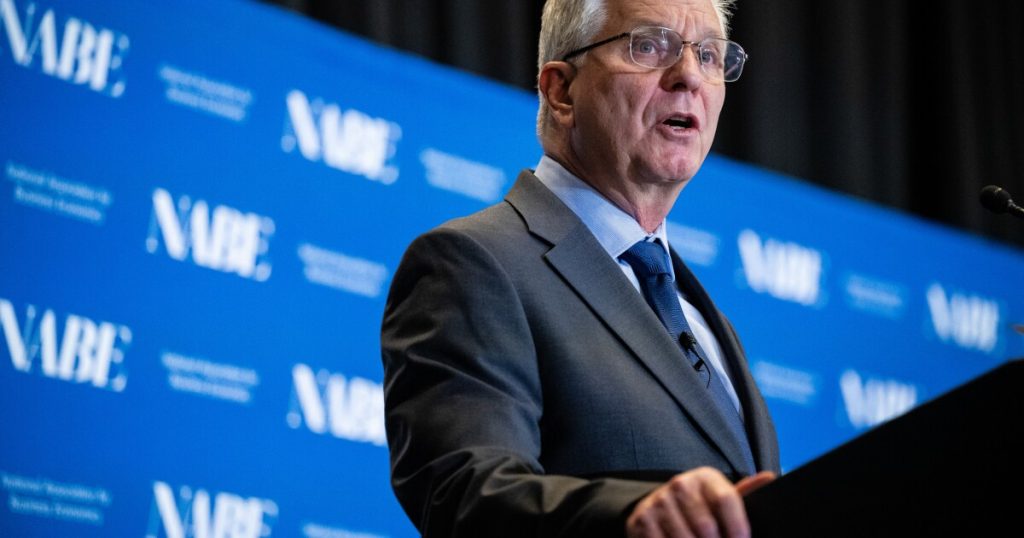
- Key takeaway: Federal Reserve Gov. Christopher Waller said he remains concerned about the labor market, but that the Iran war and its impact on energy prices have made the outlook for monetary policy more uncertain going forward.
- Expert quote: “Beyond the length of these disruptions, with this economic shock coming on the heels of the boost to prices from import tariffs, I believe there is the possibility that this series of price shocks may lead to a more lasting increase in inflation, as we saw with the series of shocks during the pandemic.” — Fed Gov. Christopher Waller
- What’s at stake: Expectations are building that the Federal Open Market Committee will leave interest rates unchanged at its April 28-29 meeting. The CME FedWatch Tool shows markets are pricing in a 99.5% probability that rates will remain steady after the next meeting.
Federal Reserve Gov. Christopher Waller said Friday that his view on the appropriate path for monetary policy will depend on whether the Strait of Hormuz remains open.
Processing Content
Speaking at an event hosted by Auburn University, Waller said that if the strait — one of the most critical shipping choke points in the world, and one through which 20% of the world’s oil passes — is fully reopened soon, any impact on inflation is likely to be temporary. But if the conflict persists for an extended period, he said,
“If the Strait of Hormuz opens and trade flows return somewhat to normal, then I can look through the effect of recent higher energy prices on inflation [and] my focus will be on how the labor market evolves,” Waller said. “If [the Strait is constrained], I’ll have to balance the risks to the two sides of the Fed’s dual mandate to determine the appropriate path of policy, and that may mean maintaining the policy rate at the current target range.”
Waller said that before the Iran war, he was concerned
“This head-snapping volatility has only made it harder to assess the state of the labor market,” Waller said. “I am going to have to get used to payroll numbers that are lower than I am accustomed to seeing in a growing economy, as well as the possibility that even several months of negative payrolls may not be the warning sign of a recession that it often has been in the past.”
But after the end of February, Waller said his attention shifted to
Waller predicts that if progress continues to fully reopen the Strait of Hormuz, energy prices in headline inflation will fade and the pass-through of higher energy to other goods and services will be limited. However, he warned that markets may be undervaluing the risk if the conflict continues, noting that consumer prices could rise as a result.
“For inflation, the risk is that the longer the conflict drags on and energy prices remain high, the more likely it is that these elevated prices will bleed into other prices, as businesses incorporate costly energy input costs in setting their prices,” he said.
Waller said the typical response to transitory shocks is to look through them, but he noted that households may be losing confidence in the Federal Reserve’s ability to bring inflation down.
“While intellectually it makes sense to look through each shock, with a sequence of shocks, policymakers need to be more vigilant,” he said. “This is because if the shocks hit one after another, they will keep inflation elevated for quite some time. The standard ‘look through’ can become problematic if businesses and households start to believe inflation is persistently high and it affects their price- and wage-setting behavior.”
Waller said uncertainty remains high on both sides of the Fed’s mandate, making it difficult to determine the appropriate path for monetary policy. “I am tempted to say it is a bit like batting averages in baseball, where an excellent result is failing two-thirds of the time, but that wouldn’t be fair to baseball — we forecasters have an even lower rate of success,” said Waller. “Anyway, add a military conflict in the Middle East to the task of predicting the course of the economy, and things get very complicated.”