
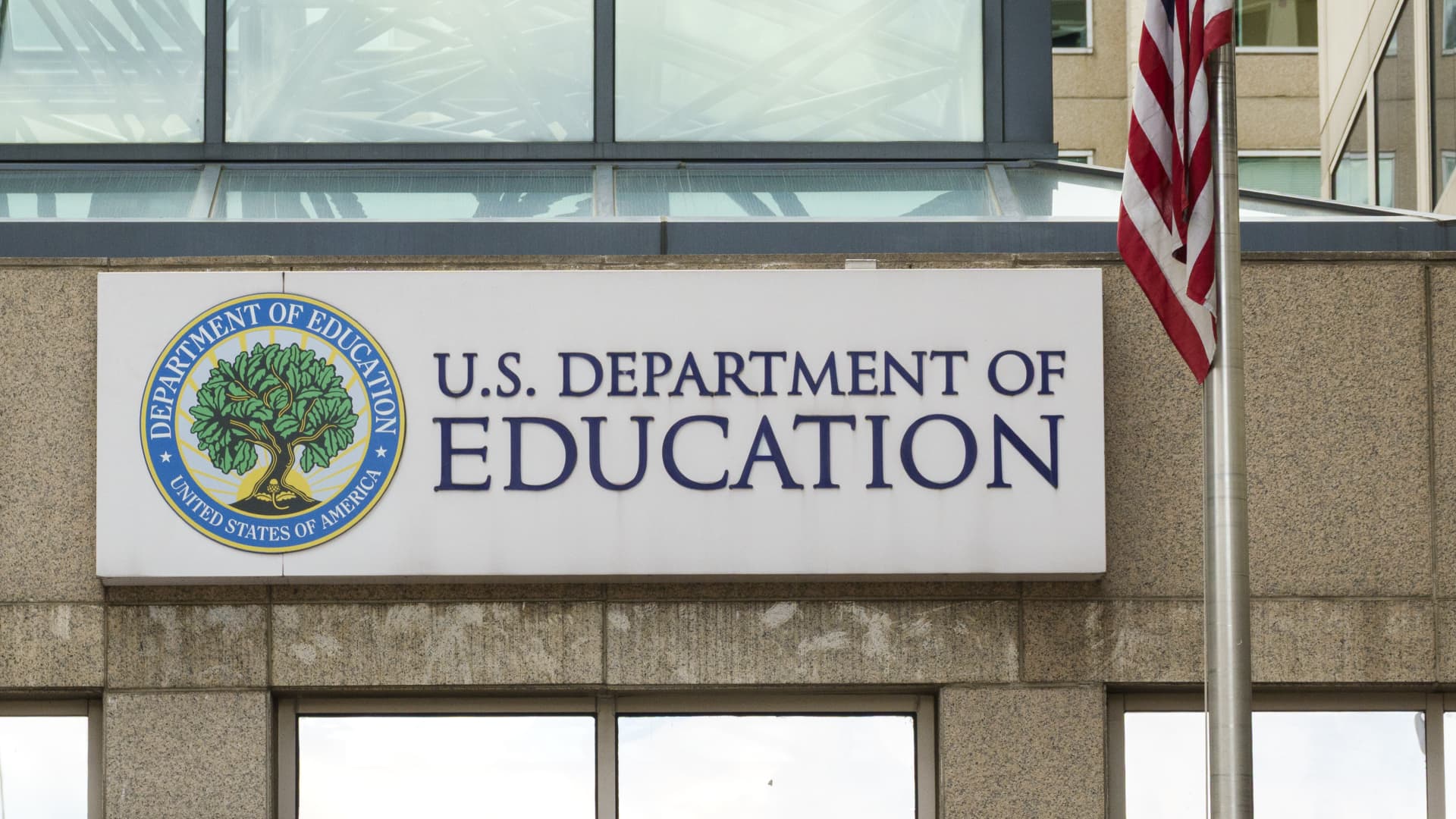
A Department of Education sign is displayed outside of their federal student aid office on May 18, 2025 in Washington, DC.
Kevin Carter | Getty Images
The U.S. Department of Education is providing conflicting information about the upcoming federal student loan borrowing limits that will take effect this summer, according to The National Association of Student Financial Aid Administrators.
A provision in President Donald Trump’s “big beautiful bill,” passed last year, established a new $257,500 lifetime borrowing cap for federal student loan borrowers as of July 1, 2026.
But the Education Department has made contradictory statements about whether certain loans taken out by graduate students — Grad PLUS loans — will count toward that new borrowing ceiling, NASFAA, a group representing college financial aid administrators, said in a statement this week.
“This approach is both irresponsible and unfair to students and financial aid professionals who are working in good faith to make informed decisions amid inconsistent and incomplete information,” said Melanie Storey, president and CEO of NASFAA, in a statement.
Ellen Keast, press secretary for higher education at the U.S. Department of Education, said the agency was in the final stages of its regulatory process on the new loan limits and would soon address these concerns.
But the uncertainty around the borrowing limits comes just as students are making their decisions about whether to go to graduate school in the fall, and which school to attend.
“The lack of clear guidance makes it difficult for students to plan for how to pay for their college education,” said higher education expert Mark Kantrowitz.
The One Big Beautiful Bill Act eliminates the Grad PLUS loan program altogether as of July 1. But those who already hold the loans may be able to borrow less going forward if the debt is used in the calculation. The lifetime limit is likely to include all previous borrowing, even if the student paid down the debt, Kantrowitz said.
Grad PLUS borrowers who are currently enrolled in school “are grandfathered in and can continue to borrow without an aggregate limit for the remainder of their education program or three years, whichever comes first,” he added.