
Processing Content
- Key insight: Stablecoin’s history hints at its future to power market-related innovation.
- Forward look: Dollar-backed stablecoins offer a decentralized window into digital finance for those outside the banking system.
-
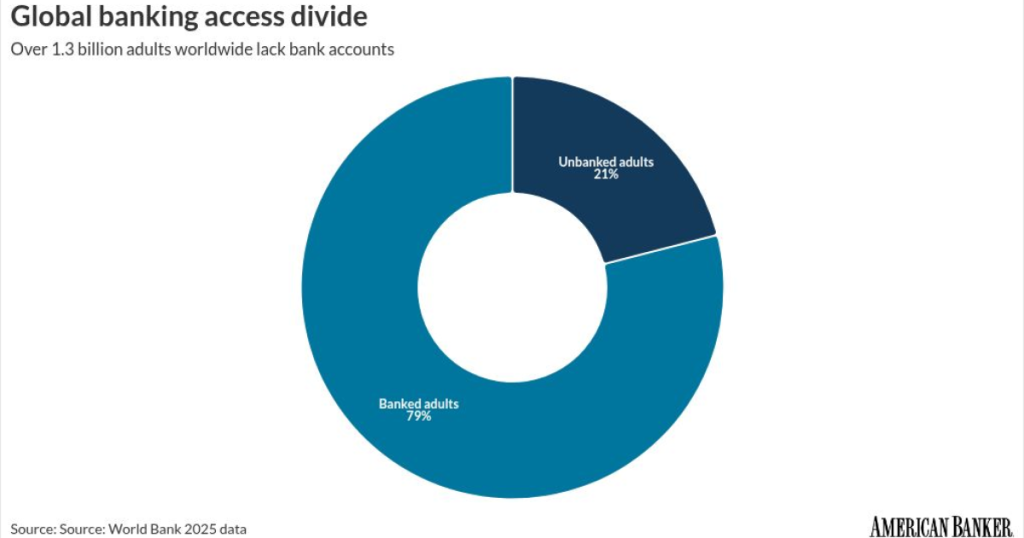
Supporting data: Over 4% of U.S. households — roughly 5.6 million — do not have a bank or credit union account, according to the 2023 FDIC biennial National Survey of Unbanked and Underbanked Households.
As traditional institutions hammer out stablecoin strategies and as new platforms emerge to facilitate their implementation, mainstream attention has been largely focused on
Yet stablecoin’s history reminds us of another vector of adoption, one largely overlooked by media reports, but which is nevertheless key to both the dominance of dollar stablecoins and their ability to power market-related innovation.
The first stablecoin designed for practical use, Realcoin, was announced as an idea in July 2014 and launched in October of that year as a dollar-pegged token on Omni, an issuance platform built on top of bitcoin. Realcoin rebranded to Tether and the dollar token to USDT the following month. Growth was slow at first but picked up during the 2017 bull market, especially once USDT launched on ethereum. Expansion to other chains followed in subsequent years, propelling the USDT token to its current $183 billion market cap.
Fine, but why did Tether emerge in the first place?
Cast yourself back to 2015. You’re interested in new technologies, and the great financial crisis drove home the risks of a concentrated financial system. You have heard mention of this new idea called bitcoin and, since you are curious, you dig deeper. You’re not a coder, but you understand enough about logic to see how the algorithm could work, and that you are looking at a protocol for permissionless payments, the first that can economically support itself without relying on a particular entity for distribution of compensation.
To get a feel for how it works, and to potentially make a profit should growing interest push the price above the current level of roughly $250, you decide to buy some bitcoin. But how would you do that?
Bitcoin Market was the first fiat-to-crypto platform. It launched in 2010, allowing the purchase of bitcoin via PayPal, but from the start it was plagued with scams and its clunky user interface operated more like a forum than an exchange.
That same year, Mt. Gox pivoted from a trading cards platform to one for bitcoin, offering a more exchange-like experience with order books and limit orders as well as euro and dollar funding. Its superior design and relatively reliable execution grabbed it a significant market share, up until its collapse in early 2014.
By then, other platforms had emerged, with more sophisticated interfaces — but fiat connectivity was a persistent problem. Using PayPal and credit cards became unworkable given the risk of charge-backs. Bank transfers were slow and limited to banking hours, unsuitable for those looking for fast execution, especially important in a young and volatile market.
In 2015, Bitfinex — established by the founders of Tether — became the first crypto exchange to accept USDT. Traders could transfer fiat to their Bitfinex account, exchange it for USDT, and then use that balance to trade in and out of bitcoin. USDT offered a stable token value with fast settlement, ideal for traders as well as longer-term investors looking for price certainty.
Then, in 2017, China banned banks from working with crypto platforms. With their fiat rails cut off, many had no choice but to offer USDT trading pairs. The token swiftly became the crypto ecosystem’s dominant settlement currency, despite the availability of fiat alternatives on Bitstamp, Coinbase, Kraken and others.
Why was it so successful? In 2017, Tether was reeling from a series of banking issues, with partners shutting accounts. Its treasury wallet was hacked. It got served with
Demand grew for USDT regardless because the token worked. It solved a real problem of fiat access restrictions; and its fast settlement turned out to be better suited for a volatile 24/7 market.
This almost immediate product/market fit highlights an overlooked stablecoin use case beyond digital asset trading: situations around the world where fiat connections are either unavailable or too cumbersome to be practical.
One such case is
Dollar-backed stablecoins are not just about easier access to a liquid, store-of-value currency; they are also a decentralized window into digital finance for those outside the banking system.
Another overlooked use case is new projects mired in bureaucracy.
While in most highly regulated jurisdictions a business without an established bank account would trigger the red flags of potential fraud or illicit finance, often the absence is due to the friction of paperwork and the high cost of jumping over numerous hurdles. Setting up stablecoin accounts not only allows revenue to start flowing on day one; it also enables payments to and from almost any jurisdiction.
Stablecoins can offer established businesses smoother and faster cross-border transfers as well as more efficient 24/7 treasury management. They can also give new businesses anywhere access to instant, global payments.
So, stablecoins are not just about faster payments and dollar access — they can also be about banking the unbanked and connecting the unconnected, enabling financial services to reach market segments that have traditionally been off limits.
What’s more, their history reminds us that the eventual utility of new technologies is rarely limited to doing the same activities only more efficiently. Rather, they are about pushing new functionalities into new markets, broadening opportunities for services brave enough to support the blurring of boundaries.